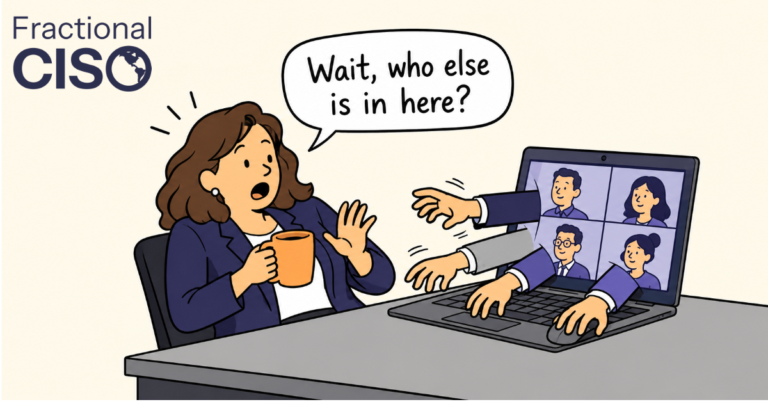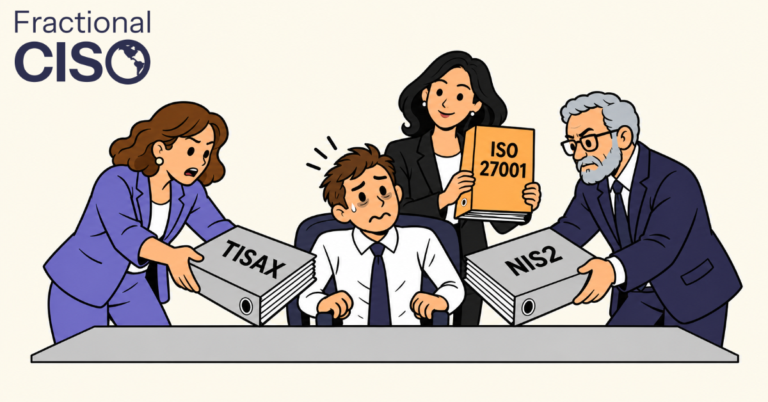

Sophia, the CTO of a healthcare SaaS startup, was already stretched thin when she learned about her 90-day deadline.
Her coffee went cold as she scrambled to find a solution. The stakes? Her organization was ready to close a $2.3 million deal with a hospital network, but with one major condition: SOC 2 Type 2 compliance within a year.
She was already managing a 12-person engineering team, two and a half product launches (long story), and a growing list of security questionnaires from new clients. After phoning a recruiter contact she quickly nabbed from HR, the outlook wasn’t good.
At best, the recruiter shared, she’d be looking at four to six months before signing on a full-time Chief Information Security Officer (CISO) to the tune of $200,000 – $300,000 annually, before benefits.
She didn’t have four to six months. She had 90 days.
Fortunately, there was a solution to Sophia’s predicament that would allow her to reach her goals within the requisite time frame. By working with a Virtual CISO (vCISO), she could implement executive-level cybersecurity leadership at a fraction of the time and cost of a full-time hire.
For businesses facing compliance deadlines, budget constraints, or rapid growth, a vCISO delivers the strategic leadership needed to achieve SOC 2, ISO 27001, or HIPAA compliance while you focus on running your business. However, many people in Sophia’s position are still unsure what a vCISO does, how they can help, and why they might be the crucial missing solution to upgrading your organization’s overall security program.
Why Compliance Frameworks Matter for Modern Businesses
Sophia’s situation is not uncommon for SaaS, or other companies, that handle their customer’s data. Trust has to be established from the start, and many companies won’t move forward without frameworks like SOC 2, ISO 27001, and HIPAA in place.
Yes, these frameworks are about security, but they’re also a reflection of an organization’s commitment to take data protection seriously.
Financial, Healthcare, and Tech Sector Pressures
Compliance across these industries can make or break business deals. Financial institutions require SOC 2 for vendors handling customer data, healthcare organizations will only move forward with HIPAA assurances, and tech companies won’t onboard suppliers who fail to produce security documentation.
If you’re feeling these pressures in your own organization, you’re not alone, especially if you’re dealing with a new client’s demands for a specific certification or dreading the unprepared feeling of that quickly approaching audit date.
Risk of Fines and Reputational Damage
Industry pressures are only part of the problem. Non-compliance can also result in fines and reputational damage, with HIPAA fines potentially reaching over $50,000 per violation.
Oversights in any of these areas can result in legal issues, lost contracts, and damaged reputation that can’t be fixed overnight. However, a vCISO can give you the confidence to navigate these high-stakes challenges correctly the first time.
The Role of a Virtual CISO in Compliance Success
Strategic Security Leadership
Before working with a vCISO, Sophia assumed that she’d be working through a compliance checklist. However, as her vCISO explained, it’s not about checking off boxes. The role of a vCISO is to act as security leadership and establish a comprehensive security management system.
They’d start with a readiness assessment, thoroughly examining where Sophia’s existing controls stood, what documentation was needed, and which gaps needed to be closed. Any changes that had to be made would require purposeful efforts in the right direction, which stood out to Sophia.
The vCISO isn’t afraid to get specific about business goals and how each security initiative must connect to and advance them. Furthermore, the vCISO can explain technical details simply and prepare her and her team for what auditors would expect to see.
Framework Alignment Without Full-Time CISO Costs
The best part? Sophia wasn’t paying full-time executive rates, but she still received all of the value and leadership abilities that come with hiring a full-time CISO.
Her vCISO was able to prepare her for multiple frameworks at the same time, as SOC 2 and HIPAA have significant overlaps in areas like access control and data protection. This crucial know-how saves Sophia time and effort by preventing duplicate work and sets her organization up for pursuing ISO 27001 in the future – should her company target a European expansion.
SOC 2 Compliance — How a vCISO Guides You
Readiness Assessment and Gap Analysis
Sophia was primarily responsible for her organization’s security program and, prior to working with a vCISO, assumed it was “mostly ready” if they ever needed a security assessment or audit. However, the results of their readiness assessment proved otherwise.
This assessment determines where the company stands and how well its existing program aligns with SOC 2’s applicable Trust Services Criteria (TSC): Security, Availability, Confidentiality, Processing Integrity, and Privacy.
A few of her organization’s key gaps included a lack of a documented incident response plan, ad hoc user access reviews, and SIEM alerts that weren’t being logged for future audits. Once these gaps were identified and explained, the vCISO’s job was to remediate each one efficiently.
Policy and Control Implementation
Like Sophia, you may be tempted to pull boilerplate security checklists from online, make a handful of tweaks, and use that for your audit. However, as her vCISO explained, auditors can tell if you’ve copied generic policies from the internet. Sure, boilerplate templates can sometimes pass audits, but they won’t help your security program. The biggest issue is that generic templates won’t address your organization’s unique security concerns.
Each policy change must be mapped to SOC 2’s specific criteria, all tied to real controls and documented policies. Additionally, it’s crucial to get into the habit of preparing and submitting evidence, as well as getting the appropriate department head sign-offs.
Audit Preparation and Evidence Gathering
Audit time can be a real nightmare for the unprepared. For many companies, organizational procrastination can leave them scrambling!
Thanks to the help of her vCISO, her organization didn’t have to scramble. She was ready and confident with everything she needed. By this point, she had already been working closely with her vCISO to:
- Conduct mock interviews and internal reviews
- Build an evidence matrix mapping controls to specific proof
- Answer audit questions
- Provide exact documentation
- Avoiding unnecessary details that could actually complicate findings
The result was a clean SOC 2 Type I report, issued on schedule and without qualifications. More importantly, the company now had a repeatable system for maintaining compliance.
HIPAA Compliance — Meeting Healthcare Privacy and Security Standards
PHI Protection Policies
Because Sophia’s SaaS product handled electronic health records for clinics, the vCISO turned next to HIPAA Security Rule alignment. The first step was to inventory every location where Protected Health Information (PHI) appeared, including:
- Databases
- Logs
- Backups
- Support systems
- Developer test data
Next, the vCISO would implement role-based access controls, encryption of data at rest and in transit, and strict data-retention limits. She worked closely with the vCISO to create logging systems to capture PHI access events and to create clear Business Associate Agreements (BAAs) for third-party processors to sign.
Risk Assessments and Remediation Plans
HIPAA requires a formal, recurring risk analysis, so Sophia’s vCISO assessed each threat based on its probability and severity. Since they had just conducted a thorough risk assessment for SOC 2, they were able to save a tremendous amount of time and effort by adapting that same assessment for HIPAA compliance.
With this comprehensive list in hand, they were able to create a remediation plan for each item, assigning an owner, target date, and verification. The vCISO tracked progress in a central register that doubled as audit evidence.
They also established quarterly reviews to ensure risk ratings evolved with infrastructure changes, especially as the company adopted new APIs and cloud services.
Workforce Training Coordination
HIPAA success (and framework success in general) hinges on the team’s ability to understand and execute according to the standard. That’s why consistent workforce training is crucial and should include:
- New-hire orientation for HIPAA overview, basics of handling PHI, and incident reporting
- Role-specific modules for developers, support, and sales each learned how their work intersected with PHI
- Annual refreshers and phishing simulations to reinforce accountability
- Tabletop exercises to practice incident escalation when PHI exposure is suspected
ISO 27001 Certification — The vCISO Compliance Advantage
ISMS Design and Documentation
The core of ISO 27001 is the development of a strong Information Security Management System (ISMS) anchored in real business operations.
ISO 27001 is particularly relevant for organizations expanding into European markets or working with EU-based clients. If Sophia’s organization decides to pursue this path, her vCISO can help her map their existing SOC 2 controls to ISO’s Annex A requirements and cross-reference them against NIST 800-53 standards.
Document control, information classification, supplier risk management, and incident response procedures are all requirements, like with SOC 2, but ISO 27001’s expectations are slightly different. An experienced vCISO can explain these nuances and help you navigate them to ensure you’re audit-ready.
Risk Assessment and Statement of Applicability
The next step would be to assess risk using a matrix that plots likelihood on one axis and impact on the other. For this process, the vCISO seeks to uncover every possible threat, catalog them (everything from credential theft to supplier outages), and then determine their likelihood and impact. Each vulnerability is tied to assets, owners, and mitigation controls in order to proactively address these threats.
A vCISO can also conduct quantitative risk assessments that translate security risks into monetary terms that leadership can understand. Since vCISOs are executive-level leaders themselves, they know how to help you (no matter your position) communicate with leadership to make better, data-driven decisions. At the very least, this is a great way to open up conversations with the executives in your organization about risk, threats, and the benefits of investing in cybersecurity initiatives.
The Statement of Applicability (SoA) is derived from this assessment, which is a master document listing all 93 Annex A controls, and marking each as implemented, planned, or not applicable. Auditors will use the SoA to verify that controls matched real operations and that risk treatment plans were thoroughly tracked.
Internal Audit Support
To fully prepare for the ISO 27001 audit, the vCISO will run their own internal audit. This doesn’t hold the same weight as a certifying body, but it’s invaluable as a sort of dress rehearsal before the official audit.
This step is crucial for uncovering weak spots and thoroughly preparing the team for the real audit. During this stage, you might uncover supplier records missing signatures, outdated access reviews, or an incident log that was accidentally left open rather than formally closed. Picking up on these early allows you to fix them, whereas during an official audit, you may not be able to complete certification.
Beyond Certification — Maintaining Continuous Compliance
Ongoing Monitoring and Periodic Reviews
Thanks to her vCISO’s help, Sophia was able to have a SOC 2 Type 2 compliance plan within 90-days, which the customer accepted. Nine months later, she was fully compliant, and even well-positioned to pursue ISO 27001 in the future!
While many organizations see a compliance audit as a finish line, they’re more like starting points. It’s important to keep every control consistent, up-to-date, and well-documented.
Sophia’s vCISO established quarterly access reviews, monthly vulnerability scans, incident logging, regular workforce training, and annual policy reviews.
Adjusting for Regulatory Changes
Trying to keep up with her own industry was enough, let alone all of the constant changes made to standards, frameworks, requirements, and other nuanced updates. Fortunately for Sophia, she didn’t have to worry about them at all.
Her vCISO, well-versed in the constantly changing nature of security standards, came prepared to make adjustments and track potential updates. It’s not uncommon for an organization to follow all of the rules and remain compliant one year, only for the framework to change so that they’re out of compliance the next. This could be catastrophic if this lapse occurred around the time of an actual breach.
Compliance is a moving target, so having a vCISO with an ear to the ground as threats evolve and technology changes… that can make all the difference.
Explore the vCISO Compliance Advantage for Yourself
Sophia’s story represents a common path for CTOs and other leaders who find themselves thrust into real-world compliance hurdles. The immediate challenge may have been achieving certification to close a huge client deal. But the lasting value was in building a security program that effectively managed cybersecurity risk and consistently maintained compliance.
Fractional CISO’s Virtual CISO Compliance Services
A vCISO brings the executive security leadership and cross-framework experience to translate complex standards like SOC 2, ISO 27001, and HIPAA into actionable steps. They’ll help create the most efficient path to compliance that is also tailored to your specific organizational needs and goals.
From gap assessments and control design to risk management and ongoing compliance monitoring, a vCISO helps organizations like yours stay audit-ready year-round, without the cost or delay of hiring a full-time executive. If you want to get compliant and not just pass an audit, but build lasting trust, explore our Virtual CISO compliance services.
Want to get great cybersecurity content delivered to your inbox? Click here to sign up for our monthly newsletter, Tales from the Click.